
If you’ve ever seen a bid broken into sections like “Division 03 – Concrete” or “Division 09 – Finishes,” you’ve already encountered CSI MasterFormat, even if no one explained what it actually was. This guide breaks down the system in plain language so you understand not just what it is, but why it directly affects how your bids get read, compared, and won.
What Is CSI MasterFormat and Why It Matters
MasterFormat is a standardized system for organizing construction specifications and cost information, published by the Construction Specifications Institute (CSI) along with Construction Specifications Canada. It’s often called the “Dewey Decimal System” of construction, because it gives every trade, material, and system a consistent, predictable place in the documentation, so anyone on a project, from architect to subcontractor, can find what they’re looking for without guessing.
The system dates back to 1963, when CSI first introduced a 16-division format. In 2004, it was expanded to the 50-division structure still in use today, to accommodate new materials, building systems, and technologies that didn’t fit cleanly into the original categories.
For contractors, MasterFormat matters because it’s the common language used across specifications, bid packages, cost codes, and change orders. When a GC asks for pricing “broken out by CSI division,” they’re asking you to organize your numbers using this exact system, and doing it correctly (or incorrectly) can affect how your bid is perceived.
Breakdown of Major Divisions
MasterFormat organizes its 50 divisions (numbered 00–49) into broad groups:
- Division 00 – Procurement and Contracting Requirements: bidding forms, contract conditions
- Division 01 – General Requirements: administrative requirements, quality control, temporary facilities
- Divisions 02–19 – Facility Construction: the core trades most contractors work in daily, including:
- Division 02 – Existing Conditions (site investigation, demolition)
- Division 03 – Concrete
- Division 04 – Masonry
- Division 05 – Metals
- Division 06 – Wood, Plastics, and Composites
- Division 07 – Thermal and Moisture Protection (roofing, insulation)
- Division 08 – Openings (doors and windows)
- Division 09 – Finishes (drywall, flooring, paint)
- Division 10 – Specialties
- Divisions 20–29 – Facility Services: mechanical, electrical, and plumbing systems (Division 21 Fire Suppression, Division 22 Plumbing, Division 23 HVAC, Division 26 Electrical, and related divisions)
- Divisions 30–39 – Site and Infrastructure: earthwork, utilities, transportation-related work
- Divisions 40–49 – Process Equipment: specialized industrial and process systems
Not every division is used on every project, many are reserved for specialized or future use, but this consistent numbering means Division 03 always refers to concrete and Division 09 always refers to finishes, regardless of which architect or GC wrote the spec book.
How CSI Codes Are Used in Estimating and Bidding
CSI divisions aren’t just an organizational convenience, they’re built directly into how bids get assembled and compared:
- Estimators use CSI divisions to structure takeoffs and cost estimates, ensuring every trade and material category is accounted for and nothing gets skipped
- General contractors roll up subcontractor bids by division, so pricing from a concrete sub, an electrical sub, and a roofing sub can be assembled into one coherent overall bid
- Owners and construction managers compare competing bids division-by-division, which makes it easy to spot when one contractor’s number for a specific division is unusually high or low compared to others — often a sign that something was missed or misunderstood in the scope
Each MasterFormat section also follows a “three-part” format internally, General, Products, and Execution, which governs how detailed specifications within a division are written, separate from the numbering itself.
Why Organized Estimates Win More Bids With GCs and Owners
Bids that are properly broken out by CSI division are simply easier to evaluate, and that works in your favor as a contractor:
- It signals professionalism and attention to detail. A bid organized by division looks like it came from someone who understands standard industry documentation, not a rough guess.
- It speeds up the bid review process. GCs and owners reviewing dozens of bids can quickly locate and compare the numbers they care about most, rather than digging through an unstructured lump-sum quote.
- It reduces disputes later. When scope is clearly assigned to specific divisions from the start, there’s less ambiguity about what was included or excluded if change orders come up mid-project.
How Proper Trade Breakdown Improves Bid Clarity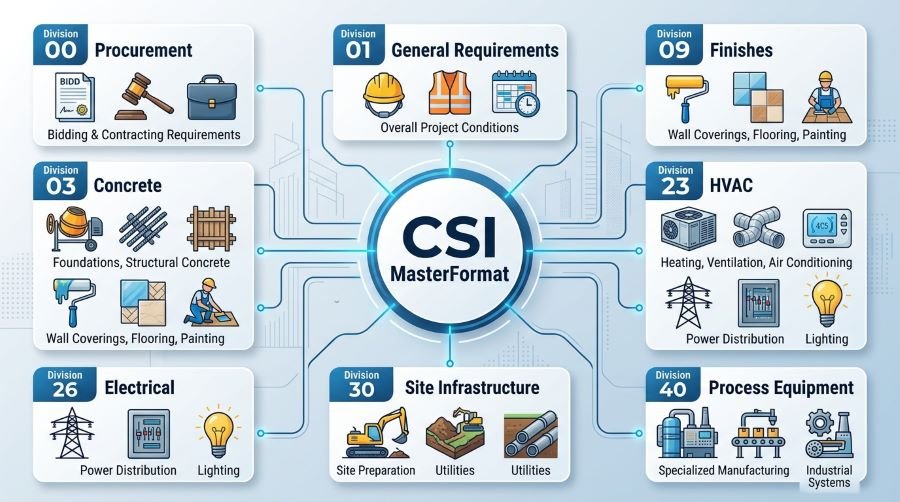
A bid that lumps everything into a single number invites questions, and questions slow down (or lose) contract awards. Breaking pricing out by trade/division does the opposite:
- It shows exactly where the money is going, which builds trust with owners and GCs evaluating multiple bids
- It makes it far easier to identify scope gaps before the contract is signed, rather than discovering them mid-project
- It aligns your bid with how subcontractor scopes, change orders, and payment applications will eventually be tracked anyway, so you’re not re-organizing the same numbers three separate times over the life of the project
Bottom Line
CSI MasterFormat isn’t just paperwork, it’s the shared structure that lets architects, GCs, subs, and owners all speak the same language when it comes to pricing and scope. Contractors who organize their estimates this way from the start submit cleaner bids, face fewer scope disputes, and make it easier for decision-makers to say yes.
Need your next bid broken out by CSI division, done right? Our estimating team builds every takeoff and cost estimate around standard MasterFormat divisions, so your bids are easy to evaluate and hard to dispute.