
Every construction estimate starts in the same place: the takeoff. Before a single price gets attached to a bid, someone has to determine exactly how much material, labor, and equipment a project requires. Get the takeoff wrong, and everything built on top of it — the estimate, the bid, the profit margin, is wrong too. This guide covers what a takeoff actually is, the different types contractors rely on, and why so many companies now outsource this step specifically.
What Is a Construction Takeoff?
A construction takeoff (also called a “quantity takeoff” or QTO) is the process of measuring and counting every material, component, and labor hour required to complete a project, based on the architectural and engineering plans.
In practice, this means an estimator works through the drawings and specifications page by page, extracting quantities like:
- Square footage of flooring, drywall, or roofing
- Linear footage of framing, piping, or conduit
- Cubic yards of concrete
- Count of doors, windows, fixtures, and fittings
- Labor hours associated with installing each item
The takeoff is the foundation of the entire estimate. Once quantities are known, current material and labor pricing is applied to produce the final cost estimate used in the bid.
Types of Takeoffs
Not every takeoff serves the same purpose. Contractors typically work with three main types:
- Material Takeoffs This is the most common type, quantifying every physical material needed for the job: lumber, concrete, steel, drywall, fixtures, and finishes. Material takeoffs are what most people mean when they say “takeoff,” and they form the basis for both cost estimating and material ordering/procurement.
- Labor Takeoffs A labor takeoff estimates the number of labor hours required to install each material or complete each task, broken out by trade. This is what allows an estimator to convert quantities into labor cost, factoring in local wage rates and crew productivity assumptions.
- Quantity Takeoffs (Combined) Often, contractors need a full quantity takeoff that merges material and labor into one document, organized by CSI division or trade, so the estimate can be assembled and compared line by line. This combined takeoff is typically what’s handed to a general contractor’s estimating team or delivered by an outsourced estimating service.
Manual Takeoffs vs. Digital/Software-Based Takeoffs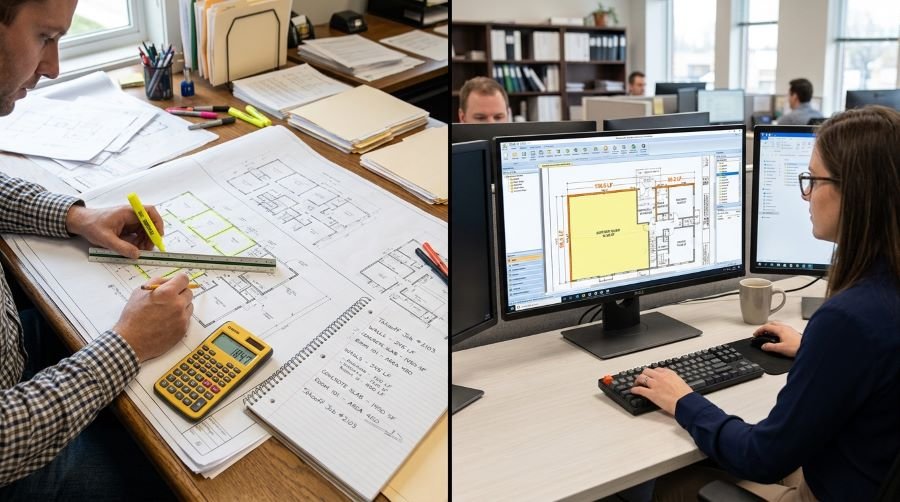
Manual takeoffs involve an estimator physically measuring quantities off printed or PDF plans using a scale ruler, digitizer, or simple on-screen measuring tools, then transferring those numbers into a spreadsheet by hand. This method is:
- Time-consuming, especially on large or complex projects
- More prone to human error (missed pages, misread scale, transcription mistakes)
- Still used by smaller contractors or on very simple projects where software isn’t worth the setup time
Digital/software-based takeoffs use dedicated takeoff software to measure directly from digital plan files (PDFs or CAD/BIM models). The estimator clicks or traces along the drawing, and the software automatically calculates area, length, or count, then feeds those quantities into a linked cost database. Digital takeoffs offer:
- Significantly faster turnaround on large projects
- Built-in error-checking (software flags missing or unmeasured areas)
- Easier collaboration when multiple estimators split a project by trade
- The ability to update quantities instantly if plans are revised
Common Takeoff Software Used in the Industry
Contractors and estimating firms commonly rely on tools such as:
- Bluebeam Revu — widely used for on-screen takeoff, markup, and measurement directly from PDF plans
- PlanSwift — dedicated digital takeoff software with built-in cost databases
- STACK — cloud-based takeoff and estimating platform
- On-Screen Takeoff (OST) by ConstructConnect
- Autodesk Takeoff — integrated with BIM/CAD workflows for larger commercial projects
Most professional estimating teams, whether in-house or outsourced, use one or more of these platforms rather than relying purely on manual measurement, simply because of the time savings and reduced error rate on anything beyond a small residential job.
How Takeoff Accuracy Impacts Your Final Bid
The takeoff is the single point in the estimating process where a small mistake compounds into a large financial problem.
- Underestimating quantities means you’ll price the job too low, then discover the shortfall mid-project when you have to buy more material at a worse price and absorb the labor to install it, often eating directly into profit.
- Overestimating quantities makes your bid uncompetitive, and you lose the job to a contractor who measured more accurately (or who quietly cut corners on materials).
- Missed items entirely, a skipped page, an unmeasured room, a trade left out of the takeoff, can turn a profitable contract into a loss, because change orders after the contract is signed are far harder to negotiate than pricing accurately up front.
Because the entire bid is built on the takeoff, most estimating professionals treat it as the highest-risk step in the process, the place where experience and attention to detail matter more than anywhere else in the bid.
Why Many Contractors Outsource Takeoffs Specifically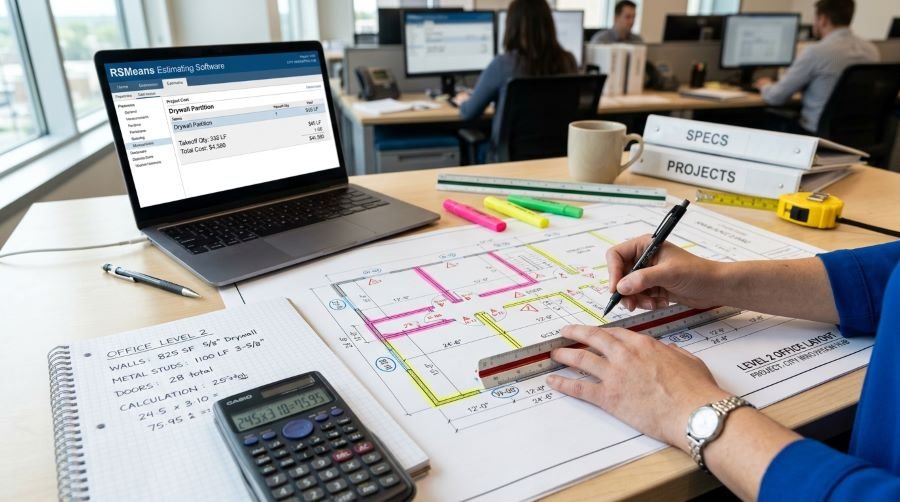
Even contractors who keep some estimating in-house often outsource the takeoff step alone, for a few practical reasons:
- It’s the most time-intensive part of estimating. A detailed takeoff on a mid-size commercial project can take many hours; outsourcing that step frees in-house staff to focus on pricing strategy, vendor negotiation, and bid assembly instead of manual measurement.
- Specialized takeoff teams work across many project types, which means they’ve likely measured something similar before and know where estimators commonly miss quantities.
- It lets smaller contractors bid on more jobs simultaneously. If takeoffs are the bottleneck, outsourcing that single step can double or triple how many bids a small team can pursue in the same week.
- Software and database costs are absorbed by the outsourcing partner, rather than requiring the contractor to license and maintain takeoff software in-house.
Final Words
A construction takeoff isn’t just a technical exercise, it’s the foundation every bid, budget, and profit margin is built on. Whether you handle takeoffs in-house, use digital software, or outsource the process entirely, the goal is the same: quantities that reflect exactly what the plans call for, with no gaps and no guesswork.
Want a second set of eyes on your next takeoff? Send us your plans and we’ll return a detailed, trade-by-trade quantity takeoff you can use to bid with confidence.