
If your bids feel harder to price accurately this year, you’re not imagining it. 2026 has brought some of the sharpest and most uneven construction material price movement in years, and it’s changing how contractors need to approach every bid they submit.
Current Material Price Trends
Unlike previous cycles, where material prices tended to rise or fall together, 2026 pricing is moving in different directions depending on the material category:
Steel, copper, and aluminum are under the most sustained upward pressure. Tariff policy has driven steel, aluminum, and copper-based products to carry a 50% tariff as of early 2026, with derivative products taxed at 25%, and industrial/electrical equipment built from those metals, including transformers and panel boards, facing an additional 15% tariff. Copper in particular remains tight due to strong demand from electrical work, infrastructure, and data center construction, which is limiting availability of related equipment.
Lumber has been more stable by comparison but remains volatile. Framing lumber has traded in a wide band through the year; even after modest seasonal dips, year-over-year lumber costs have still run meaningfully higher, driven largely by constrained Canadian softwood supply and a 10% tariff on softwood lumber (25% on derivative products).
Concrete and cement have seen more modest but steady increases, driven in part by new EPA kiln regulations that are pushing older, higher-emission cement plants to close, tightening supply just as infrastructure-driven demand stays strong.
The overall picture: nonresidential construction input prices surged at a 12.6% annualized rate during the first two months of 2026 alone, the fastest pace since the supply chain disruptions of early 2022. Industry forecasts generally point to baseline construction cost escalation of 4–6% for the year, with higher increases likely in tariff-sensitive or labor-intensive trades.
Why Fluctuating Prices Make Fixed-Bid Estimating Risky
A fixed-price bid locks in your cost today for work that may not happen for weeks or months. In a stable pricing environment, that’s a manageable risk. In 2026’s environment, it’s a different story:
- Price changes are now happening within weeks rather than quarters, making it harder to estimate confidently even a month or two out
- A material cost increase of just 20% on a mid-size project can eat through 50–70% of the expected profit margin if it isn’t accounted for in the bid
- Long-duration projects are especially exposed, since more time between bid and material purchase means more opportunity for prices to move against you
This is compounded by an ongoing labor shortage, the industry needs to attract roughly 349,000 net new workers in 2026 just to keep supply and demand in rough balance, a figure that’s expected to climb further in 2027. Tight labor availability amplifies the impact of material cost swings, since delays caused by understaffing stretch out the window during which pricing risk is live.
How Contractors Can Protect Margins
- Use escalation clauses. For any project running longer than a few months, building an index-linked escalation clause into the contract, tied to an objective benchmark like the Bureau of Labor Statistics Producer Price Index, allows for price adjustments based on real market data rather than absorbing the full risk yourself.
- Diversify suppliers. Relying on a single vendor for a critical material leaves you exposed if that supplier’s pricing or availability shifts. Maintaining relationships with three to five vendors per critical material gives you leverage and backup options when prices spike.
- Buy ahead when cash flow allows. Locking in pricing on high-risk materials before a price jump, even if it means paying modest storage costs, can be significantly cheaper than absorbing an escalation later in the project.
- Build a contingency line into every estimate. Rather than pricing materials at today’s exact cost, add a buffer that reflects the realistic volatility of that specific material category, since a uniform “add 3% to everything” approach no longer reflects how unevenly prices are moving.
The Role of Real-Time Cost Data in Estimating
Because steel, lumber, copper, and concrete are now moving on separate cycles, an estimate built on outdated or generic pricing assumptions can be wrong before the bid is even submitted. This is where updated, trade-specific pricing data makes a measurable difference:
- Estimates built on current material pricing databases reflect this week’s market conditions, not last quarter’s
- Regional pricing data matters more than ever, since tariffs and supply constraints are hitting different markets unevenly
- Faster access to updated pricing lets contractors reprice a bid quickly if a project’s timeline shifts
How Updated Pricing Databases Improve Bid Accuracy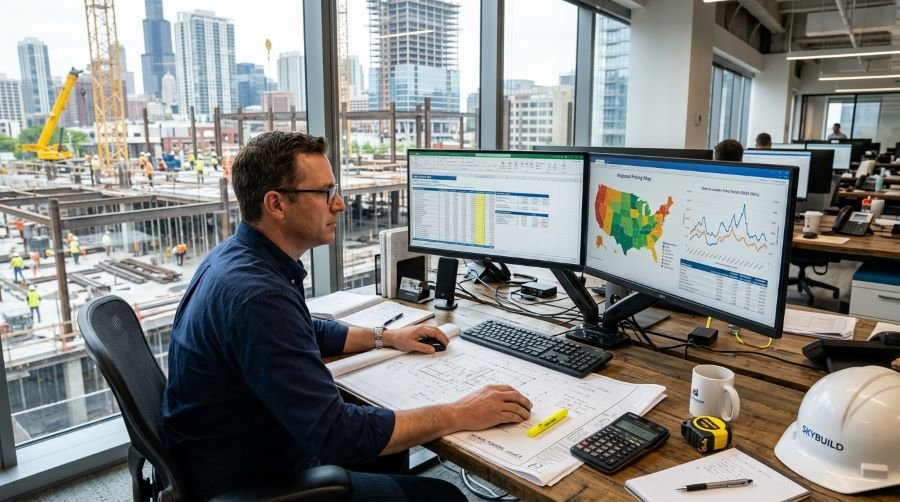
Professional estimating teams, whether in-house or outsourced, typically maintain or subscribe to pricing databases that update far more frequently than a contractor could track manually across every material category. This matters directly at the bid stage:
- Bids built on current pricing are less likely to require costly change orders later
- Owners and GCs increasingly expect escalation language and current pricing assumptions to be reflected in submitted bids, particularly on longer-duration work
- Accurate, current estimates protect your margin without pricing yourself out of competitive bids
Final Words
2026 isn’t a year where material prices are simply “up”, it’s a year where different materials are moving on entirely different timelines, which makes generic pricing assumptions more dangerous than usual. Contractors who build escalation protection into contracts, diversify suppliers, and estimate off current pricing data are the ones protecting their margins while competitors get caught by surprise cost jumps.
Need an estimate built on current material pricing? Our team tracks pricing shifts across trades so your next bid reflects real market conditions, not last quarter’s numbers.