
Every contractor has been in that meeting the one where a client slides a printed number across the table and says, “I saw online that a four-bedroom house costs around $400,000. Can you build it for that?”
The answer, as any experienced builder knows, is: it depends. But that’s not what clients want to hear. What they want is a number they can plan around. Your job is to give them one that’s accurate, defensible, and profitable for your business.
This guide breaks down the real cost of a four-bedroom house from the contractor’s perspective covering everything from hard construction costs and material breakdowns to regional pricing, finish levels, and the line items that homeowner-focused articles always miss.
What Does a 4 Bedroom House Actually Cost to Build?
Before getting into specifics, here’s the honest range contractors should be working within:
- Entry-level build: $130 – $160 per square foot
- Mid-range residential: $175 – $260 per square foot
- Premium/custom build: $280 – $500+ per square foot
Most four-bedroom homes fall between 2,000 and 2,800 square feet. That puts total hard construction costs land excluded somewhere between $260,000 on the low end and $1.4 million on the high end.
The wide range isn’t vagueness. It reflects real differences in geography, material specs, labor markets, and design complexity. A contractor in rural Georgia building a spec home operates in a completely different cost environment than one building a custom residence in suburban Denver.
Cost Breakdown by Trade: Where the Budget Actually Goes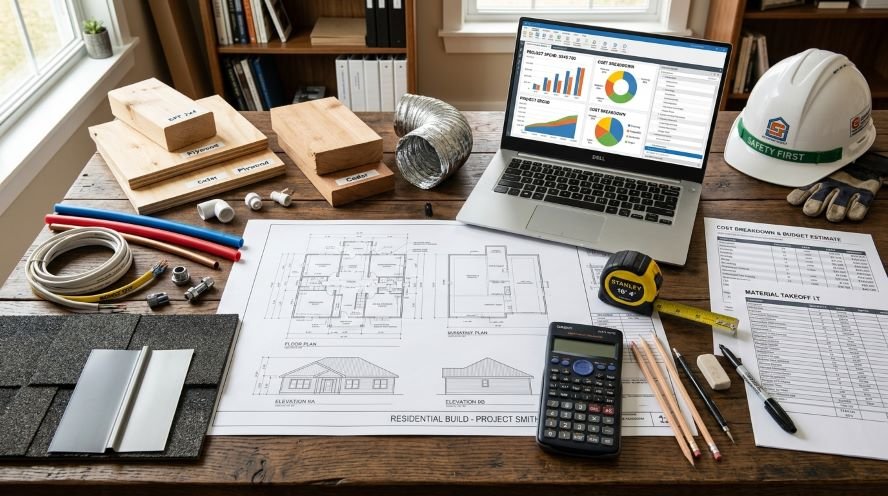
Knowing how each component contributes to total cost makes you a stronger estimator and a more persuasive communicator with clients who question your numbers.
Foundation and Site Work — 10% to 15% of Total Budget
The ground has to be ready before anything else begins. Site clearing, grading, excavation, and foundation work routinely run $30,000 to $65,000 on a standard four-bedroom build.
Soil type is the variable most clients don’t think about. Expansive clay, poor drainage, or high water tables can require engineered solutions that add $15,000 to $40,000 before a single wall goes up. Always conduct a soil analysis before finalizing your estimate on any raw lot.
Framing — 15% to 20% of Total Budget
Framing labor and lumber together typically land between $40,000 and $90,000 on a four-bedroom home. Roof design drives a lot of this cost a simple gable roof is far less expensive than a complex hip or multi-pitch design that requires more cutting, more labor hours, and more waste.
Lumber pricing has remained volatile since 2020. Build escalation provisions into any contract with a timeline exceeding six months, or lock in material pricing with your supplier early.
Plumbing, Electrical, and HVAC — 20% to 25% of Total Budget
These three mechanical trades combined will consume $80,000 to $110,000 on a mid-range four-bedroom build. It’s the category where subcontractor relationships make or break your schedule and your margin.
Broken down individually:
- Plumbing (rough-in through finish): $18,000 – $30,000
- Electrical (service, rough-in, panel, fixtures): $20,000 – $38,000
- HVAC (equipment, ductwork, installation): $18,000 – $35,000
Higher-end systems — zoned HVAC, tankless water heaters, smart electrical panels push these numbers up significantly. Make sure your client’s expectations on system specs are locked down before subcontractors are priced.
Roofing — $14,000 to $35,000
Asphalt shingles on a standard four-bedroom home land in the $14,000 to $22,000 range installed. Metal roofing, synthetic slate, or clay tile can push that to $35,000 or well beyond. Roof pitch and complexity matter as much as material selection.
Insulation and Drywall — $20,000 to $45,000
Insulation is where energy code compliance adds cost. Many jurisdictions have tightened blower door and thermal envelope requirements, pushing more clients toward spray foam — which costs more per square foot but performs better and reduces long-term utility costs.
Drywall hang and finish is labor-intensive. Regional labor rates drive this cost more than material pricing.
Windows and Exterior Doors — $18,000 to $45,000
Window count, size, and specification matter here. A four-bedroom home with large picture windows and a dramatic entry door will land near the top of that range. Standard double-hung vinyl windows on a budget build keep costs lower, but increasingly, energy codes mandate minimum U-factor and SHGC ratings that push clients toward better units regardless.
Interior Finishes — $55,000 to $200,000+
This is where builds diverge most dramatically, and where client conversations get most difficult. Interior finishes include:
- Flooring (hardwood, tile, carpet, LVP)
- Cabinetry and hardware
- Countertops (laminate vs. quartz vs. stone)
- Interior doors and trim
- Paint and wall finish
- Lighting fixtures and plumbing fixtures
A budget four-bedroom build can land at $55,000 for finishes. A high-spec custom build with designer cabinetry, natural stone, and wide-plank white oak floors can exceed $200,000 — on finishes alone.
Setting explicit allowances in your contract and documenting upgrade pricing is non-negotiable on any project where the client hasn’t made firm finish selections before signing.
How Location Changes Your Numbers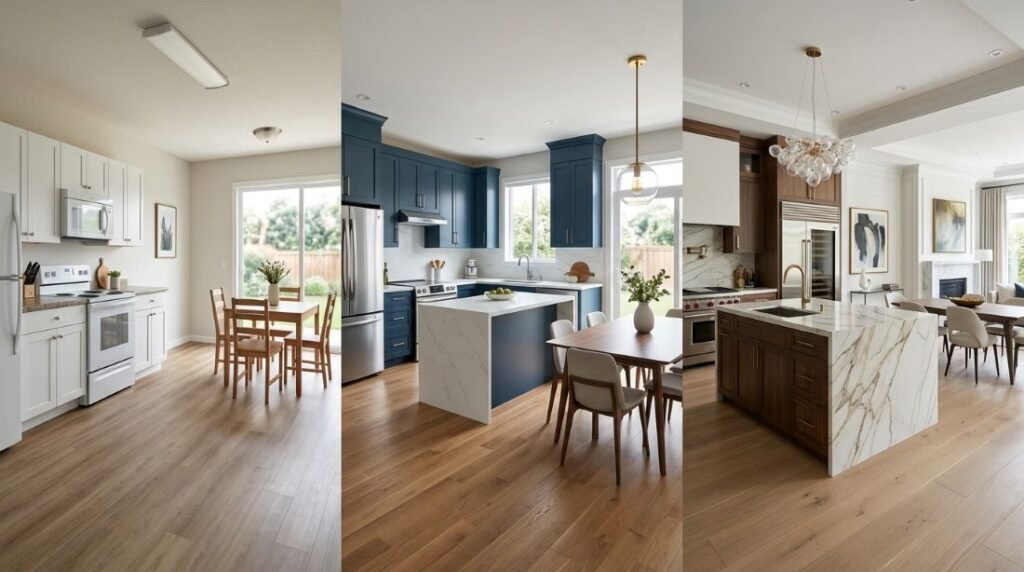
Your regional market is the most powerful variable in construction pricing. The same four-bedroom plan will carry wildly different costs depending on where you’re operating.
Southeast and Midwest markets: Tend to offer the most favorable labor and material rates contractors in these regions can often deliver a solid mid-range four-bedroom home in the $175 to $220 per square foot range.
Sunbelt growth markets: Phoenix, Dallas, Charlotte, Nashville have seen labor costs tighten significantly as builder demand outpaces skilled trade supply. Expect $200 to $280 per square foot in these markets.
Western metros: Denver, Salt Lake City, Seattle run $240 to $360 per square foot for mid-range work. Custom builds push higher.
High-cost coastal markets: Greater New York, the Bay Area, Los Angeles represent a different world entirely. Labor rates, regulatory burden, and land costs combine to make four-bedroom builds routinely cost $400 to $600+ per square foot in construction costs alone, before land or soft costs are factored in.
Know your market, build your pricing on current local subcontractor bids, and stop relying on national averages to set client expectations.
The Cost Items Clients Never Budget For
Part of your value as a contractor is helping clients understand the full financial picture before the contract is signed not discovering gaps at framing.
Permit and impact fees: Depending on the municipality, permits and development impact fees can range from $5,000 to $50,000+. Some Florida and California jurisdictions charge impact fees exceeding $30,000 per unit. Pull your local fee schedule and include it in every estimate.
Utility connections: Getting water, sewer, gas, and power to the structure especially on raw land can add $10,000 to $40,000, depending on how far the connections run.
Driveway, grading, and landscaping: Most clients don’t realize these aren’t included in a standard construction contract unless explicitly stated. Budget $8,000 to $30,000 for driveway and exterior finish work.
Temporary facilities and site overhead: Portable toilets, temporary power, site fencing, dumpster rental these costs add up across a 10-to-14-month build.
Protecting Your Margin on a Four-Bedroom Project
A four-bedroom home is typically a $350,000 to $700,000 contract. At that size, margin erosion can be significant if you’re not running a tight ship.
Experienced residential contractors target 15% to 22% gross margin on new construction. Below 15%, you’re operating without a buffer for the surprises that always show up.
Three practices that protect margin most effectively on larger residential builds:
- Detailed line-item estimating not square-footage multipliers. The more granular your takeoff, the fewer gaps for scope creep to exploit.
- Change order discipline every client-initiated change gets documented, priced, and signed before work proceeds. This isn’t bureaucracy; it’s basic business protection.
- Subcontractor scheduling delays from unavailable subs create cascading costs: extended equipment rentals, crew downtime, pushed inspection dates, and frustrated clients. Build your sub relationships and schedule them early.
Final Word
The average cost of a four-bedroom house spans an enormous range and that range exists because the variables are real and significant. Your competitive edge isn’t undercutting that range. It’s understanding it precisely, communicating it clearly, and delivering within it consistently.
Clients who trust your estimates become repeat clients. Repeat clients refer other clients. That’s how residential contracting businesses grow one well-priced, well-built four-bedroom home at a time.
Price it right. Build it right. And make sure every client walks away knowing exactly what they paid for and why it was worth every dollar.