
Every contractor eventually asks the same question: should we hire our own estimator, or send takeoffs to an outside estimating firm? The answer affects your overhead, your bid volume, and ultimately how many jobs you win. There’s no universal right answer — it depends on your bid volume, project mix, and growth stage. This guide breaks down both models with real numbers so you can make the call with confidence.
What In-House Estimating Involves
Building an in-house estimating department means hiring, training, and retaining dedicated staff whose only job is pricing work before it’s ever won.
The real cost is higher than a salary line. According to 2026 salary data, construction estimator pay in the U.S. typically runs from the low $80,000s at the national average up into the $90,000s, with senior and chief estimators commanding $110,000–$175,000 depending on region and project complexity. Entry-level “Junior Estimator” roles still average roughly $75,000–$85,000 in most states. On top of base salary, employers carry payroll taxes, benefits, software licenses (takeoff and estimating platforms), a workstation, and training time pushing the fully loaded cost of one estimator well above the quoted salary.
Hiring is slow and competitive. Experienced estimators are in short supply industry-wide. Firms report that mid-level estimators, the ones who can run a bid independently — have seen the steepest pay increases of any experience tier in 2026, a sign of how tight the talent pool is. A vacant estimating seat can sit open for months, during which bids either don’t go out or get rushed by whoever is available.
Capacity is fixed. One or two in-house estimators can only process so many takeoffs per week. During slow bidding seasons, you’re paying full salary for underused capacity. During busy seasons, exactly when you need to chase every opportunity, that same team becomes the bottleneck that limits how many jobs you can bid at all.
What Outsourced Estimating Involves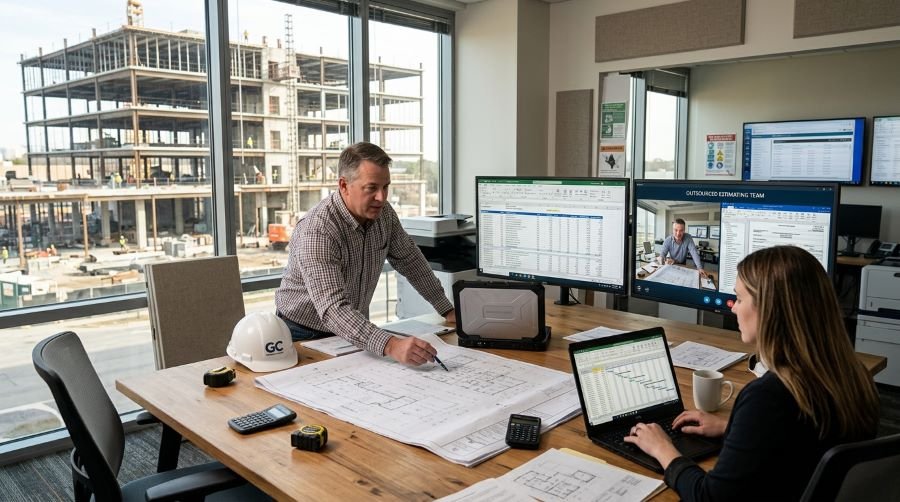
Outsourced estimating means sending your plans and specs to a third-party estimating company that returns a completed, itemized takeoff and cost estimate, without adding anyone to your payroll.
The process is straightforward:
- You upload plans and specifications (or the estimating company pulls them from your project portal)
- The estimating team performs the quantity takeoff by trade or CSI division
- Current material and labor pricing is applied
- You receive a detailed, itemized estimate, often within 24–72 hours depending on project size
- Some firms also provide bid-day support to help you finalize numbers before submission
Cost structure is usage-based, typically priced per project, per square foot, or per trade package, rather than as a fixed salary. This means you only pay for estimating work tied directly to a bid you’re pursuing.
Turnaround scales with demand. Because outsourced firms staff multiple estimators across many clients, they can absorb a sudden spike in bid opportunities without you having to hire, train, or manage anyone new.
In-House vs. Outsourced: Side-by-Side Comparison
| Factor | In-House Estimating | Outsourced Estimating |
| Cost structure | Fixed salary + benefits + software, year-round | Pay-per-project or per-bid, scales with volume |
| Typical annual cost | ~$75,000–$175,000+ per estimator, fully loaded | Fraction of that, tied to actual bids pursued |
| Speed to scale up | Weeks to months to hire and train | Immediate — no hiring cycle |
| Capacity during peak season | Limited to headcount on staff | Flexible, can absorb bid surges |
| Accuracy consistency | Depends on individual estimator’s experience | Backed by teams using current pricing databases across many markets |
| Software/tooling cost | Company purchases and maintains licenses | Included in service cost |
| Institutional knowledge | Builds deep familiarity with your company’s standards over time | Requires clear specs/scope communication per project |
| Best for | High, steady bid volume with consistent project types | Variable bid volume, seasonal peaks, or lean back-office teams |
When In-House Estimating Makes Sense
In-house estimating tends to pay off when:
- Your bid volume is high and consistent enough to keep one or more estimators fully utilized year-round
- Your projects are highly specialized (e.g., heavy civil, industrial process work) where deep, company-specific institutional knowledge compounds in value over time
- You want direct, immediate control over the estimating process and same-day access to whoever built the number
- You have the cash flow to absorb a fixed payroll cost even during slower months
When Outsourcing Makes Sense
Outsourcing tends to be the stronger choice when:
- Your bid volume fluctuates seasonally and you don’t want to carry year-round salary for peak-season capacity
- You’re a smaller GC or subcontractor that can’t yet justify a six-figure in-house hire
- You need to bid more jobs than your current team can handle without adding permanent headcount
- You want access to current material pricing data across multiple regions without maintaining that research in-house
- You’re trying to protect margins during a period, like 2026, when material costs are moving quickly and pricing accuracy is harder to keep current internally
The Case for a Hybrid Approach During Peak Bidding Season
Many contractors don’t have to choose one model exclusively. A common and effective approach is:
- Keep a lean in-house estimator (or estimating lead) who owns your standard project types and maintains relationships with GCs and owners
- Route overflow work, extra bid packages, unfamiliar project types, or surges during peak bidding months, to an outsourced estimating partner
- Use outsourced estimating as a pressure valve so your in-house team never becomes the reason you had to pass on a bid opportunity
This hybrid model gives you the institutional consistency of an in-house estimator with the elastic capacity of an outsourced team, without paying for a second or third full-time hire you may only need for a few months a year.
Final Words
There’s no single “correct” estimating model, only the one that matches your current bid volume, cash flow, and growth stage. If your pipeline is unpredictable, outsourcing (or a hybrid model) usually protects your margins better than carrying fixed estimating overhead. If your volume is high and steady, an in-house team can pay for itself many times over.
Not sure which model fits your business? Our team can run a sample estimate on your next project so you can compare turnaround, accuracy, and cost against your current process, no commitment required.